Despite half a century of efforts to improve water quality and restore fisheries in America’s Chesapeake Bay, its ecological health continues to decline. A new study from NumbersUSA quantifies this ecological decline within the Chesapeake Bay watershed, explores its causes, and discusses possible futures.
As the third largest estuary on Earth, the Chesapeake Bay is an essential nursery for global marine life, a key feeding stop on the Atlantic migratory bird flyway and a priceless resource for residents and visitors alike. Between 1982 to 2017, new development eliminated more than 5,000 square miles of natural and agricultural lands in the Chesapeake Bay’s watershed (Figure 1). Analysis of the most recent official data finds that most of this rural land conversion was caused by rapid population growth — a nearly six million increase during the study period — and most population growth was driven by immigration into the region.
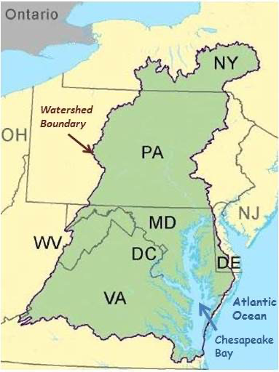
Figure 1. Boundary of the Chesapeake Bay Watershed, encompassing 41 million acres (64,000 square miles) spread across six U.S. states
The new study, Watershed Woes, finds that sprawling development within the Chesapeake Bay watershed (CBW) has led to significant habitat loss and increased air and water pollution over the past four decades (Figure 2). Between 1982 and 2017, the study found:
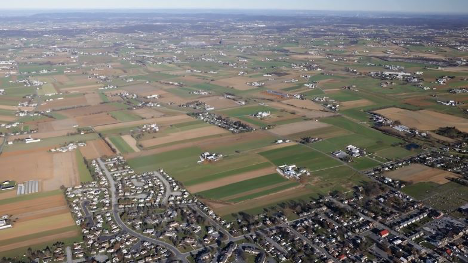
Figure 2. Sprawl proliferating across the Chesapeake Bay Watershed landscape
The CBW has seen many land use changes over the past forty years, including conversion of dirt and two-lane roads to paved multi-lane highways, the creation of new suburbs and towns, and recently the proliferation of data centers and their associated utility infrastructures. But the most consequential change, according to the new study, has been a massive increase in the regional population (Figure 3).
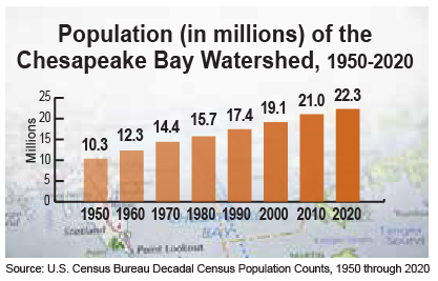
Figure 3. Population Growth in the Chesapeake Bay Watershed Counties from 1950 to 2020
The new study quantifies the loss of rural lands (both natural and agricultural areas) to urban and suburban development in the CBW’s 191 counties and independent municipalities in six U.S. states: Virginia, Maryland, Delaware, West Virginia, Pennsylvania and New York. It analyzes the relative importance of the two main drivers of rural land loss: population growth and growth in per capita land use. It projects future sprawl rates for the CBW based on a range of immigration levels and associated population growth rates. And it considers the likely ecological impacts of different population policies going forward. Among its findings:
Between 1982 and 2017, according to the most recent data from the U.S. National Resources Conservation Service, 3,228,600 acres (5,045 square miles) of natural and agricultural land were converted to developed uses in the CBW. 84 percent of all sprawl in the CBW occurred in three of the six watershed states: Virginia (36%), Pennsylvania (31%), and Maryland (17%) (Table 1).
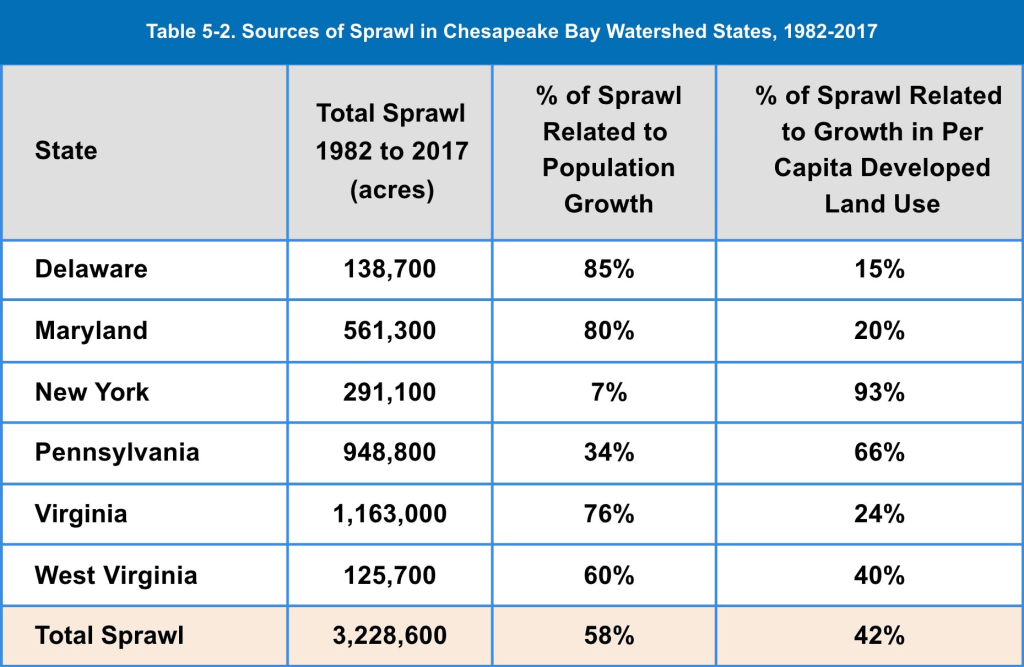
Table 1. Amount and Sources of Sprawl in CBW Watershed Counties and Municipalities, 1982-2017
The area of developed land in the CBW increased by 71% during the study period. Although official figures are not yet available for the eight years since 2017, it appears development has continued apace in the region.
The study compared changes in per capita land use, which are influenced by multiple factors, with the single factor of population, which increased by 5.9 million in the CBW from 1982 to 2017. Analysis of recent data finds that 58% of rural land conversion was caused by population growth, with 42% caused by increased per person land use (Table 1 and Figure 4). Both factors thus appear to be important in driving overall sprawl.
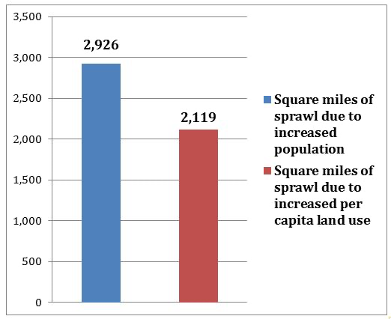
Figure 4. Rural Land Lost to Population Growth vs. Rural Land Lost to Increased Per Capita Land Use in CBW Counties, 1982-2017
In a more recent 15-year subset of the study period, 2002-2017, the study found population growth accounted for 71% of the 742,400 acres (1,160 square miles) of sprawl in the total watershed, while growth in per capita developed land use caused only 29%. Thus population growth’s role as a driver of sprawl in the watershed appears to have become more pronounced over time.
Per capita land use has been increasing in the Chesapeake Bay watershed over the past four decades. Optimistically assuming this problem can be solved, and projecting the same rate of per capita land use that existed in 2017 for the rest of this century, Figure 5 shows the implications for rural land loss in the CBW by 2100 under three plausible population scenarios.
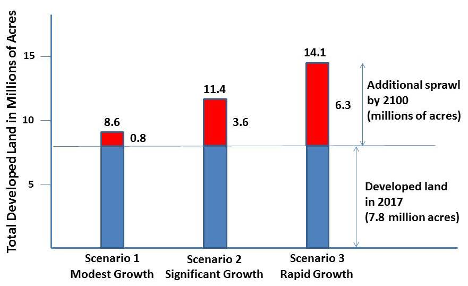
Figure 5. CBW Sprawl Projections to 2100 under Modest, Significant and Rapid Population Growth Scenarios
Under Scenario 1 with modest population growth, total developed land would increase from approximately 7.8 million acres to 8.6 million acres in the CBW (a 10% increase). Under Scenario 2 with significant population growth, developed land would increase to 11.4 million acres (a 46% increase). Under Scenario 3 with rapid population growth, developed land would sprawl to 14.1 million acres (an 81% increase), or 6.3 million more acres lost to development.
Any changes in per capita land use, up or down, will also influence future sprawl rates. But with population growth driving 71% of sprawl in the most recent period analyzed, population trends seem set to largely determine whether sprawl continues to displace agriculture and native species in the CBW.
During the study period, the population of the CBW increased at essentially the same rate as the U.S. as a whole (38% and 40% respectively) and the authors assume that in the future these populations will continue to move roughly in tandem. With U.S. fertility rates projected to remain well below replacement level, future population growth in the CBW will primarily be a function of future immigration levels. Figure 6 depicts projected population growth in the CBW under three plausible scenarios of annual net national immigration: one million, two million and three million. All three scenarios hold fertility rates steady and gradually increase longevity.
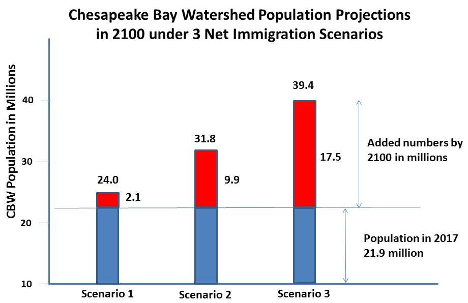
Figure 6. CBW Population Projections to 2100 under Three Different Net Immigration Scenarios: one, two and three million annual net migration into the U.S. as a whole
At one million annual net migration nationwide, the CBW population would increase by 2.1 million to 24.0 million by 2100, or an increase of 10%. At two million annual net migration, population increases by 9.9 million to 31.8 million, or an increase of 45%. And at three million annual net migration, the CBW population would increase by 17.5 million to 39.4 million, or an increase of 80%.
Clearly, U.S. immigration numbers will have an enormous effect on the number of residents in the CBW in the future — each one a consumer of resources generating pressure to use and develop rural land.
As a wise person once said, “an estuary provides a report card on its watershed.” A recent report from the non-profit Chesapeake Bay Project confirmed that the six watershed states are failing to protect the CBW or restore the Bay to health. This new report card gave area governments a C for protecting wetlands, a D for phosphorus pollution in the Bay and an F for water clarity and preserving the region’s oysters and anadromous fish stocks.
In response, the report’s authors advocate better land use planning, tightened pollution controls and efforts to restore degraded lands. All these efforts are necessary. But so is ending sprawl: the continued loss of agricultural and wild lands to new development. And the reality is that going forward, whether the human population continues to grow and devour land in the CBW and degrade water quality in Chesapeake Bay will largely be determined by U.S. immigration policy.
Sprawl in the CBW is driven primarily by population growth. State and local “smart growth” efforts can reduce sprawl somewhat through good planning, zoning and transportation policies. But such efforts are bound to be swamped if the U.S. population continues to increase by many millions every decade, with significant numbers of these additional residents seeking a home within the Chesapeake Bay watershed.
The good news is that the region’s residents support strong action to rein in sprawl. In conjunction with this study, NumbersUSA commissioned a randomized, controlled poll from Rasmussen Reports of 1030 likely voters from across the CBW. Of note, 80 percent or more of poll respondents were concerned about sprawl and rapid population growth in the Chesapeake Bay watershed (questions 1 and 2) and more than 90 percent of respondents believe it is important to protect the remaining farmland, forests, wetlands and open spaces within the CBW from development (question 6). Three quarters of respondents believe recent population growth in the Chesapeake Bay region has been too rapid and should be slowed (question 11), while a majority believe the federal government should reduce immigration as part of doing so (question 12).
The science is clear. The people have spoken. Will the politicians listen ? A healthy and vibrant Chesapeake Bay is within reach (Figure 7) — but only if Americans are willing to limit their own numbers.
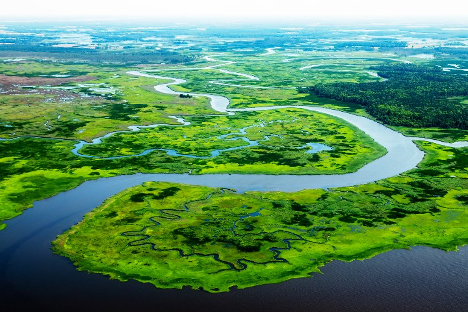
Figure 7. Salt marsh in Dorchester County, Maryland. The Transquaking River discharges into Fishing Bay near Blackwater National Wildlife Refuge. Photo credit: Will Parson/Chesapeake Bay Program.
Related Resources


 Facebook
 LinkedIn
 Tweet
Tweet
 Email
Email
 Print
Print
 Videos

 Factsheets
 Articles