Sen. Ruben Gallego (D-AZ) is pressing the Departments of Labor, Homeland Security, and Justice to investigate the H-1B program. His warning is measured but unmistakeable:
“Companies are increasingly hiring foreign workers on temporary H-1B visas while simultaneously laying off American workers.”
Sen. Gallego noted that tech companies laid off hundreds of thousands of Americans this year while hiring 30,000 H-1B workers. Laid off workers will be entering a job market that ZipRecruiter describes as “The Great Freeze.”
Gallego is not questioning the value of skilled immigrants; he is questioning a system that appears to sideline young Americans even as companies claim no domestic talent exists.
Unemployment for young workers (20-24) is twice the rate of the national average, hindering their ability to pay rent or move out of their parents’ homes. Gallego’s letter expresses particular concern for these young Americans struggling to enter the workforce:
“At major public technology companies, employees between the ages of 21 and 25 made up 15 percent of the workforce in January 2023. By July 2025, that number had dropped to 6.7 percent. These statistics suggest that there are young American workers eager to be trained for and to fill these roles.”
“…while the overall unemployment rate has remained relatively flat, the unemployment rate for young workers has continued to climb, reaching 7.4 percent in June.”
“…the average student borrows over $30,000 to pursue a bachelor’s degree. 6 But even this is no longer enough; since the start of 2020, the median home price has risen 55.7 percent, while average wages have only increased 26.6 percent.”
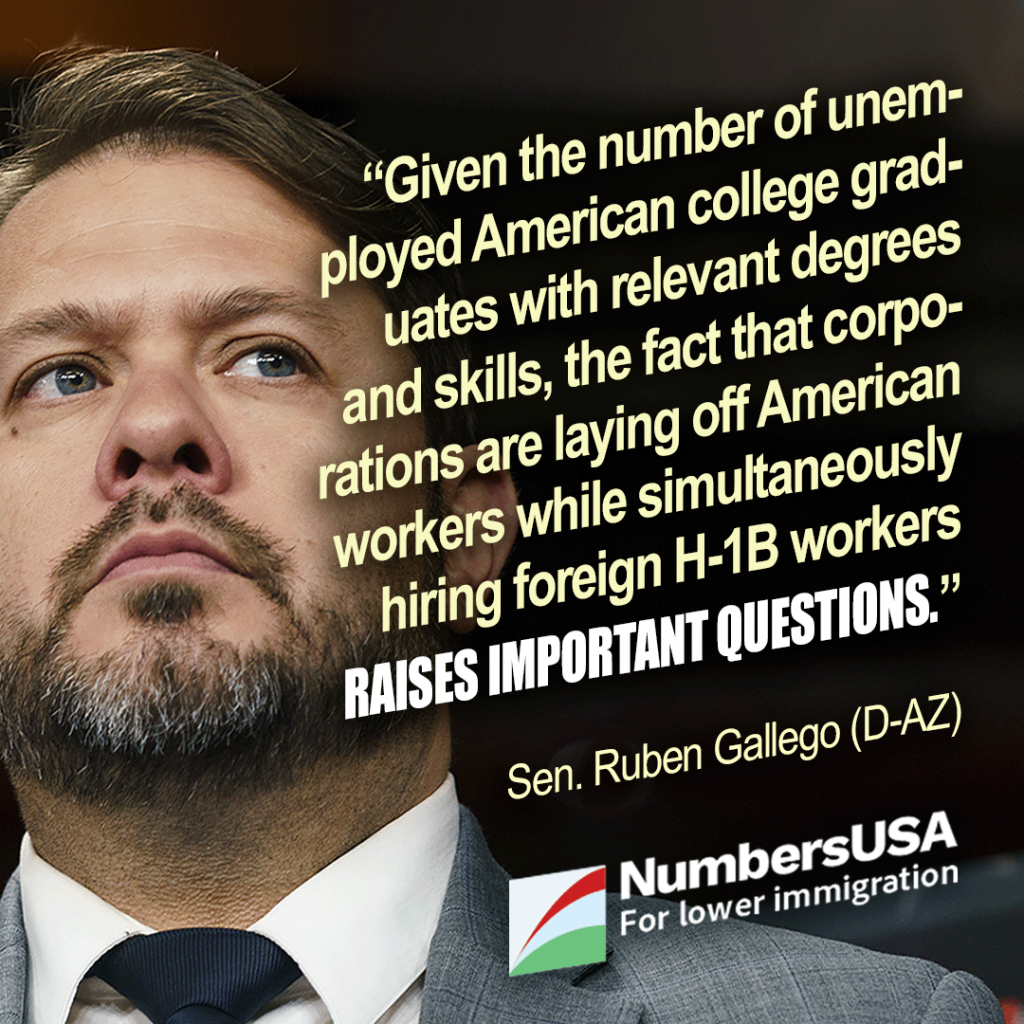
“Given the number of unemployed American college graduates with relevant degrees and skills, the fact that corporations are laying off American workers while simultaneously hiring foreign H-1B workers raises important questions.”
Gallego’s questions are not new. What is new is how clearly today’s labor market confirms what critics have warned about for decades.
The H-1B visa was created in 1990. Supporters claimed it would serve to fill temporary labor shortages primarily in STEM fields while the American education system could start to produce sufficient domestic workers of our own. From the beginning, influential voices argued that expanded temporary worker programs would “ease labor shortages” –a formulation that conveniently aligned with employer interest in suppressing wage growth. The National Science Foundation had been clamoring for expanded immigration to hold down salaries. Congress complied, first with the H-1B program in 1990, followed by the OPT program shortly thereafter. The F1-OPT-H1B pipeline has fulfilled the desire for cheaper workers, and then some.
Foreign students use the F-1 visa to gain access to the U.S. labor market. As the no-longer-active H1visajobs.com once explained, students look for “an employer willing to offer a job on OPT (Optional Practical Training) followed by STEM extension and sponsorship for H-1B visa.” Under this system, universities increasingly function not just as educators, but as gateways to the U.S. labor market–and, eventually, permanent residency. Unsurprisingly, demand is high. The U.S. issued 400,000 student visas in FY2024.
In his tour-de-force article for Compact Magazine, H-1B watchdog Professor Norman Matloff states plainly:
“The H-1B program was deliberately set up to hire younger, cheaper foreign workers in lieu of older, more expensive Americans.“
Ray Marshall, Secretary of Labor under President Jimmy Carter, described the H-1B visa program as “one of the best con jobs ever done on the American public and political systems.” That might explain why it has survived this long. Despite more and more Americans across the political spectrum demanding change, the H-1B program continues unabated.
Whether by design or by drift, the result has been a labor pipeline that advantages employers while narrowing opportunity for American graduates.
Major tech companies have been caught bypassing domestic talent. In a May 2000 congressional hearing on the impact of H-1B visas on American workers, John W. Templeton, author of an annual report called “Silicon Ceiling: Equal Opportunity in High Technology,” said:
‘We started to look at the issue of fair employment in high technology, and it did not take us long to intersect with the H-1B.’ One employer reportedly explained the lack of hiring from HBCUs and black professional organizations as a matter of convenience: ‘The H-1B is easier, I need the body count.”
Fact Sheet: H-1B
Sen. Gallego is standing up for workers, students, and recent graduates who have played by the rules and deserve a fair shot. At a moment when too many policymakers look the other way, Gallego is doing exactly what responsible oversight requires.
Related Resources
 Articles
 December 2, 2021


 Facebook
 LinkedIn
 Tweet
Tweet
 Email
Email
 Print
Print
 Videos
 Factsheets