
 Published by
Henry Barbaro
Published by
Henry Barbaro
Debates over the Endangered Species Act (ESA) have intensified in recent years, with controversies surrounding proposed legislation such as H.R. 1897, the “Endangered Species Act Amendments Act of 2025.” This bill would make changes to enforcement, habitat definitions, and economic tradeoffs. But this focus on the ESA itself overlooks a more fundamental issue: the law is inherently reactive, and by the time it is applied, the impacts it is meant to remedy are often already far advanced.
At the same time, the United States continues to experience population growth, with immigration playing a dominant role in recent decades. Immigration levels, which are set at the discretion of Congress, determines the pace of population increase. In turn, that growth shapes the extent of development–driving land conversion, infrastructure expansion, and increasing pressure on natural systems. These are the drivers of habitat loss, which accounts for almost all species declines.
The ESA does not affect these drivers. Instead, it operates downstream, and is triggered only after a species has already been driven to being threatened or endangered. By then, populations are often small and fragmented, and the landscapes they rely on have been significantly altered. Recovery becomes difficult not only because of biological constraints–such as reduced genetic diversity–but also because the habitat needed for recovery no longer exists in sufficient quantity or quality.

Florida panther — protected from extinction, but not from habitat loss
The experience of the Florida panther illustrates these limits. Intensive ESA protections helped prevent extinction, and the population has grown modestly—from about 20 animals in the 1970s to roughly 200 today. Yet the species remains largely confined to South Florida, with expansion into its historic range constrained by ongoing development. In 2026, conservation groups sued federal agencies over approval of a massive development in core panther habitat, arguing that thousands of acres would be lost and that the project could push the species closer to the point where recovery is no longer possible. Even with ESA protections in place, habitat loss continues, highlighting the limits of late-stage intervention.
This reactive approach limits what the ESA can realistically achieve. While it can prevent outright extinction, the ESA’s legal requirements rarely restore species to their full historical range or ecological role. Habitat protections are often confined to remnant areas, and potential restoration efforts are constrained by cost, competing land uses, and political resistance.
Human population growth amplifies these challenges. As America’s immigration-driven population expands, demand for housing, transportation, water, and energy grows as well. Development spreads into previously undisturbed areas, fragmenting ecosystems and isolating wildlife populations. The ESA’s project-by-project framework is not designed to address this kind of broad, systemic pressure.
For those concerned with biodiversity and preventing extinctions, the priority must be stopping habitat loss–not reacting to it. Slowing the rate of population growth would reduce the need for continual land conversion and help preserve larger, more intact ecosystems. Because immigration policy is driving U.S. population growth, changes in that policy can have critical “downstream” environmental benefits. A lower rate of population increase would ease pressure on land and water resources, maintaining conditions that allow wildlife to thrive before species reach crisis levels.
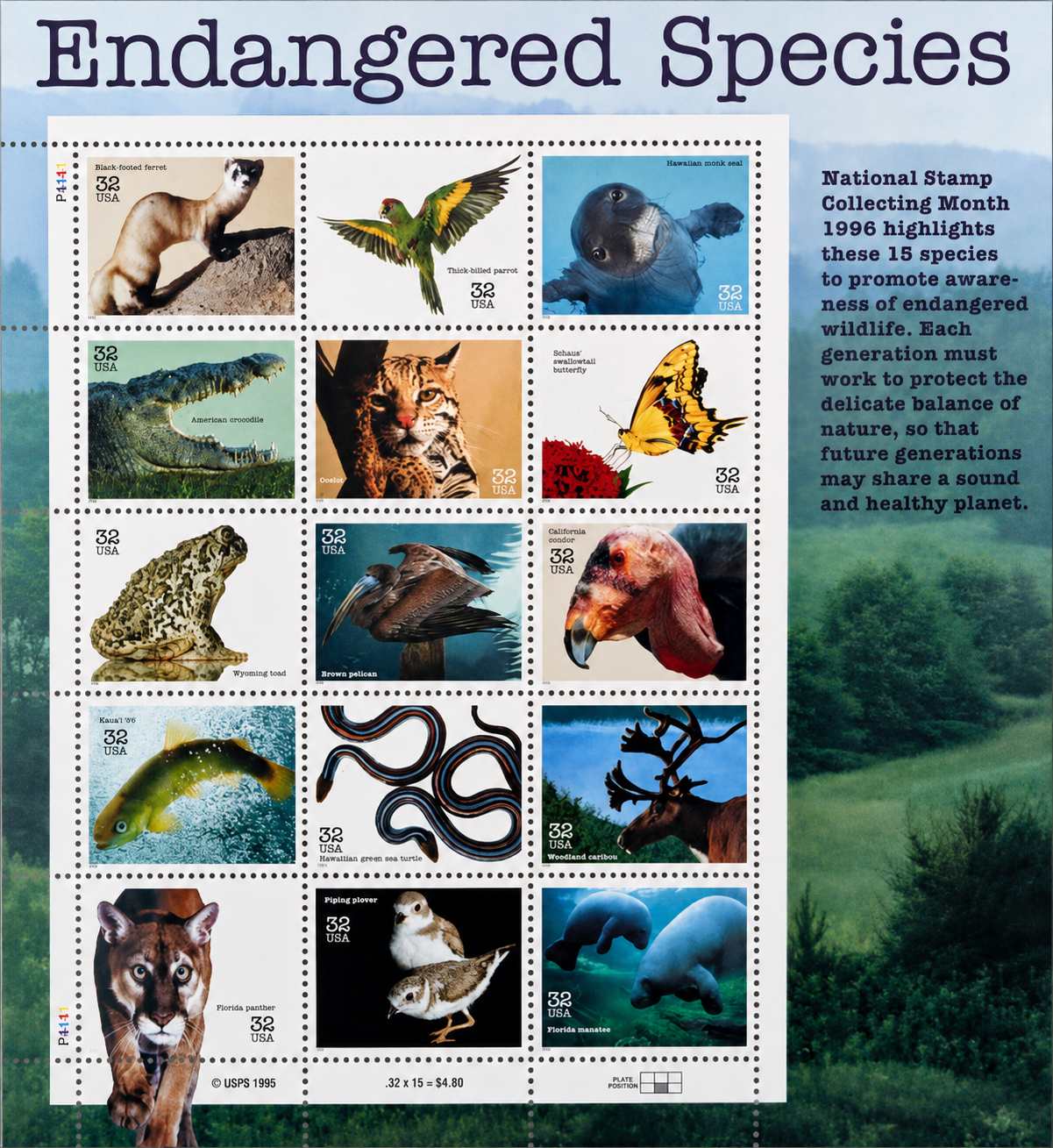
A 1996 USPS commemorative stamp pane featuring 15 endangered species reflected growing national concern over biodiversity loss. Since then, the Florida manatee and American crocodile have improved to “threatened” status, while the remaining 13 species pictured are still endangered. Many continue to struggle because the underlying drivers of decline—habitat loss and fragmentation—have persisted despite decades of ESA protection.
None of this diminishes the value of the Endangered Species Act; it remains a vital safeguard against extinction. But it cannot, on its own, compensate for the impacts of perpetual human expansion. If conservation begins only after species are already in decline, the options for recovery will likely be extremely limited or gone altogether. Ultimately, the best approach to protecting biodiversity is not to simply respond to ecological crises, but to prevent them from happening in the first place.
Find the latest updates and actions on your Action Board.
Related Resources
 Factsheets
November 4, 2023


 Facebook
 LinkedIn
 Tweet
Tweet
 Email
Email
 Print
Print
 Videos
 Articles