“Because continued population growth in the Chesapeake Bay Watershed and the U.S. as a whole is now driven by immigration, the solution to sprawl must include immigration reduction. Our current path is unsustainable. Immigration levels must be reduced to halt the population growth and land conversion that are driving biodiversity losses in the CBW and degrading Chesapeake Bay’s water quality, commercial fisheries and ecological health.” [emphasis added]
— Executive Summary, Watershed Woes: Population Growth and Sprawl Degrade Chesapeake Bay and its Watershed, 2026, NumbersUSA
In January 2026 NumbersUSA released a new study called Watershed Woes: Population Growth and Sprawl Degrade Chesapeake Bay and its Watershed. Our study showed that immigration-driven population growth is a major driver of urban sprawl within the watershed, and therefore a major factor in the degradation of Chesapeake Bay itself.
Chesapeake Bay possesses vast economic and cultural significance for millions of residents of the region and the nation. Economically, a healthy bay supports fisheries, tourism, recreation, shipping, and aesthetic amenities for its residents and visitors, generating billions of dollars in annual revenue. Culturally, the bay is a rich source of heritage, identity, and a cherished way of life for many, particularly those involved in commercial fishing and water-related activities.
The non-profit Chesapeake Bay Foundation extols the virtues of the bay’s watershed thus:
“From providing an important source of drinking water to supporting a seafood industry that sustains families and generations-old ways of life, the Chesapeake Bay watershed is an integral part to the human health and wealth of more than 18 million people. When the Bay suffers, our economy, environment, and way of life suffer too.”
The bay’s commercial seafood industry alone accounts for $2.8 billion in annual sales and $490 million in income; it is responsible for nearly 20,000 jobs in the regional economy.
Yet, in a grim reminder of the challenges the bay faces, even after years of expensive cleanup efforts, public health departments in the region must still caution people to avoid the bay’s waters after storms to avoid contact with harmful bacteria and pollution.
The Chesapeake Bay Program lists the values, functions, and resources that are at risk from the persistently degraded state of the bay environs:
Bald Eagles — Once decimated by now banned persistent pesticides like DDT, the bay’s population of bald eagles has rebounded significantly over the past half century. Yet our national symbol is still threatened by nesting disturbance from people and our noisy machines and by habitat loss.
According to the Chesapeake Bay Program: “When forests along the shoreline are cut down or disrupted by development, bald eagles have a more difficult time breeding and building nests.”
Blue Crabs — The Chesapeake Bay Program states: “The Bay’s signature crustacean supports important commercial and recreational fisheries. But pollution, habitat loss and harvest pressures threaten blue crab abundance.”
In the past half century, the bay provided an estimated one-third of the nation’s entire commercial blue crab harvest. Yet their numbers crashed a quarter century ago and remain historically low.
Healthy Forests — Healthy forests in the Chesapeake Bay watershed (CBW) help ensure a healthy bay. But over the years, massive human population growth and associated development, exploitation, pollution, and invasive species (such as the exotic fungus that causes the chestnut blight that wiped out American chestnuts by the millions) have degraded and reduced the area of the watershed’s forests.
Groundwater — The U.S. Geological Survey found that groundwater contributes 54 percent of the total annual flow of streams in the CBW.
When contaminants on the land surface seep into aquifers, groundwater can become polluted. Many human activities threaten groundwater, including leaking storage tanks; abandoned containers of hazardous materials; uncontrolled spills; fertilizers and pesticides sprayed on lawns and crop fields; salts applied to roads during winter; leaking landfills (leachate); and septic systems, among others. When population increases, these activities all increase proportionately.
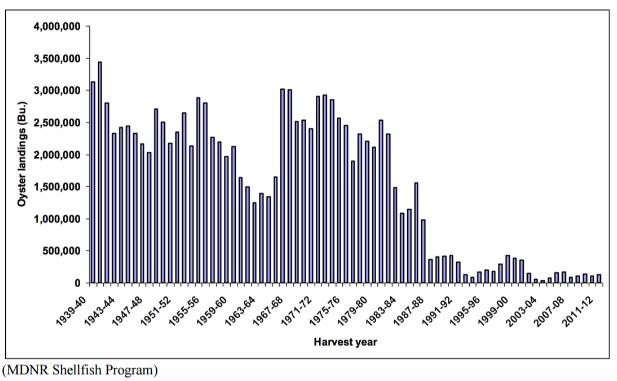
Oysters — Over-harvest, pollution, disease, and habitat loss have contributed to the decimation of oyster habitat and the plunge of oyster numbers in Chesapeake Bay. The oyster population has plummeted to a mere one percent of its historic levels.
Rivers and Streams — The landscape of the CBW is laced with an intricate web of many thousands of streams, creeks, and rivers. These transport and discharge an estimated daily average of 51 billion gallons of fresh water into the bay.
While some of the bay’s tributaries remain healthy, fishable, and swimmable, others are degraded or impaired by rubbish and debris, nutrients, suspended sediments, and toxic contaminants. In addition, dams, impoundments, culverts and other artificial structures can adversely affect the health and ecological integrity of rivers and streams.
American Shad — This species of anadromous herring was once the most valuable finfish fishery in the Mid-Atlantic region. However, its stocks were badly depleted by historic mismanagement: overfishing, pollution, and construction of dams that blocked its migration up and down the Chesapeake’s tributaries. Federal and state efforts to conserve and manage shad in the bay include harvest restriction, restocking, and removal of dams and other blockages.
Unfortunately, these efforts have not resulted in any substantial increase in shad numbers to date.
Underwater Grasses — Underwater grasses (a type of submerged aquatic vegetation) form plant communities in Chesapeake Bay that provide food and shelter for waterfowl, fish, shellfish, and invertebrates. They are a good indicator of the bay’s environmental health.
A long time ago, when Chesapeake Bay was much healthier, it may have contained as much as several hundred thousand acres of underwater grasses and submerged aquatic vegetation. Since World War II however, with the boom of development in the watershed and explosion of human activity in the bay itself, there has been a marked decrease in the area of grass beds from water quality degradation. The retreat of submerged grass beds has been one of the most significant and conspicuous signs of Chesapeake Bay’s decline.
Wetlands — Wetlands are found at the interface between land and water. They include tidal and brackish marshes, swamps, and bogs — low-lying areas where the ground is inundated or saturated by water some, most, or all of the time. Wetlands are vital ecological components of both Chesapeake Bay and its watershed, providing a number of “ecosystem services,” including flood protection and wildlife habitat.
Wetlands used to be regarded as wastelands — “too wet to walk on and too dry to swim in” — but fortunately attitudes and protective regulations by the federal and state governments have improved in recent years.
All of the values mentioned above are threatened by the widespread and increasing environmental footprint of human activity in the CBW.
The Chesapeake Bay Program, begun in 1983, is a multi-jurisdictional, inter-agency organization that collaborates across the boundaries of six states to protect and restore the entire CBW.
Yet even after billions of expenditures from the overtaxed public purse, the Program itself admits it has had only partial success. In good part this is because the underlying stresses placed on the bay have only increased as its watershed’s human population has grown by about six million since the Program started.
Projections to the year 2100 — While the Program does important work that should be encouraged and expanded, its efforts will ultimately come to naught unless the spigot of immigration-driven population growth is turned off or at least slowed down. The bar chart below shows just how influential future immigration rates will be in determining CBW population size over the rest of this century. Scenario 1 holds net immigration at 1.0 million annually; scenario 2 at 2.0 million; and scenario 3 at 3.0 million.
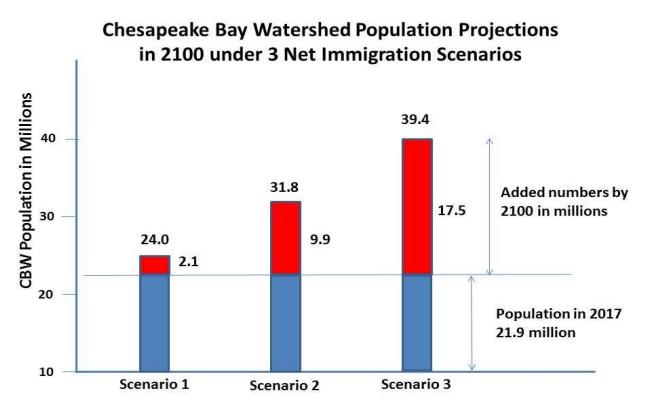
Better land use planning, more stringent and effective pollution controls, and efforts to restore degraded lands are all needed to save the bay. But so is ending sprawl and the unrelenting loss of agricultural and wild lands to new development. The fact is that going forward, the extent to which the population continues to grow and devour land in the watershed and degrade water quality in Chesapeake Bay will largely be determined by federal immigration policy.
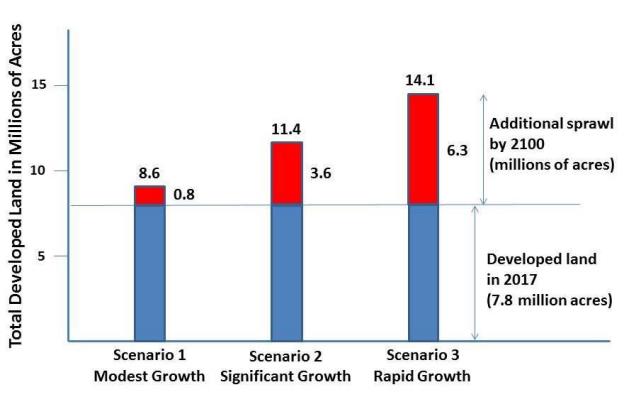
Sprawl in the CBW is driven primarily by population growth, amplifying the land-use impacts of large yards and one-acre estates. State and local “smart growth” efforts–through improved planning, zoning, and transportation policies–can help slow the pace of sprawl. However, these efforts will be overwhelmed if the U.S. population continues to grow by millions each decade, with many new residents seeking housing within the Chesapeake Bay watershed.
Because continued population growth in the CBW — and the U.S. as a whole — is now driven by immigration, the solution to sprawl must include immigration reduction. Otherwise, population growth and land conversion will continue to drive biodiversity losses and degrade Chesapeake Bay’s water quality, commercial fisheries, and overall ecological health. A healthy and vibrant Chesapeake Bay is within reach — but only if we have the courage to address our own numbers.
Related Resources


 Facebook
 LinkedIn
 Tweet
Tweet
 Email
Email
 Print
Print
 Videos

 Factsheets
 Articles