“If federal [immigration] policies driving national population growth continue … [California’s] environment and quality of life for residents will pay an ever higher price for the nation’s unwillingness to stabilize its population.”
— Sprawl in California, 2000
In the coming months, NumbersUSA will release a new study showing how immigration-driven population growth crushed the California dream. This is our second study focused on California.
A quarter century ago, NumbersUSA founder Roy Beck and I published the first in what would become an ongoing series of seventeen studies on population growth and urban sprawl in America. If any one state exemplified the post-World War Two population boom and resulting urban sprawl, it would be California.
Since then, we’ve published studies of California’s neighbors — Oregon, Arizona and Nevada — as well as our recent national study, From Sea to Sprawling Sea. This coming week, we will be publishing our most recent study, on sprawl in the Chesapeake Bay Watershed. But it all started in California in 2000.
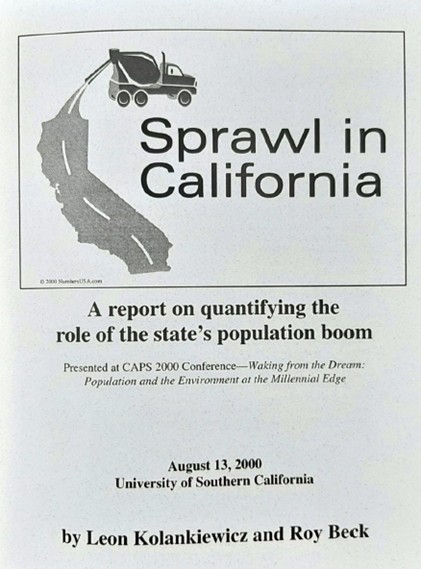
Roy presented the findings of our research — Sprawl in California: A Report on Quantifying the Role of the State’s Population Boom — at a conference held in August 2000 at the University of Southern California.
In previous decades, the L.A. metropolis had marched south into Orange County, north into the San Fernando Valley, and east towards Riverside and San Bernardino. Only the unpavable Pacific Ocean prevented sprawl to the west.
Meanwhile, urbanization in the San Francisco Bay Area metastasized north into Marin County, northeast toward Sacramento, east towards Stockton and the Central Valley, and south to San Jose and what would become known as Silicon Valley.
These were just the two largest of 28 Urbanized Areas (UAs) in California in 1990, as designated by the U.S. Census Bureau. In the twenty years between 1970 and 1990, these sprawling UAs devoured some additional 1.1 million acres of rural lands in the state.
Roy and I argued that the federal immigration policies forcing relentless population growth on California and the nation were grossly unsustainable and harmful — to the environment, ordinary citizens and taxpayers, and the working class. If mass immigration continued, we predicted that both the environment and the quality of life for everyday Californians would take a huge hit.
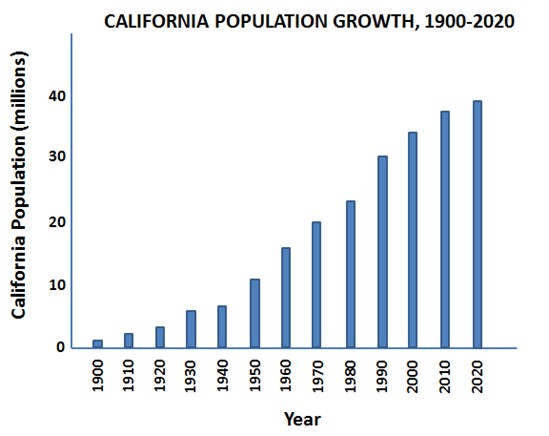
Unfortunately, both our prediction and the warnings of many others went unheeded by our political leaders. California, already at a staggering 34 million in 2000, grew by another three million to hit 37 million in 2010, and by still another 2.5 million to reach 39.5 million by 2020.
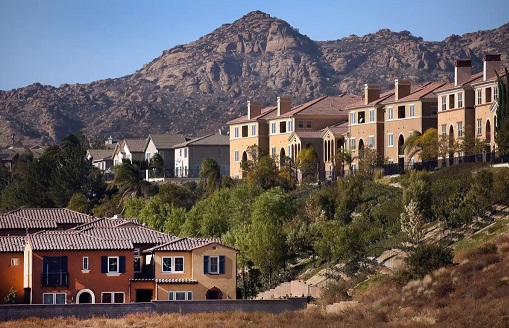
Urban sprawl in California exposes more people and properties to serious fire risk
The Covid-19 pandemic and the state government’s excessive response to it seemed to serve as a tipping point. For the next few years, California’s population actually shrank slightly, reversing a long-term upward trend that had persisted for more than 120 years. The number of Californians had exploded from 1.5 million in 1900 to nearly 40 million in 2020 — a 27-fold increase!
In the early nineties, I was a California resident. My first child was born in Anaheim, four miles from Disneyland. But by 1995, I had joined the gathering exodus of exasperated Californians to greener pastures.
En masse, we were fleeing the erstwhile Golden State’s increasing overcrowding, traffic congestion and pollution. Its water shortages, wildfires and skyrocketing housing costs. Its faltering economy, job displacement, crime and ethnic tensions. Its declining quality of life and growing political dysfunction.
All of these are symptoms of overpopulation.
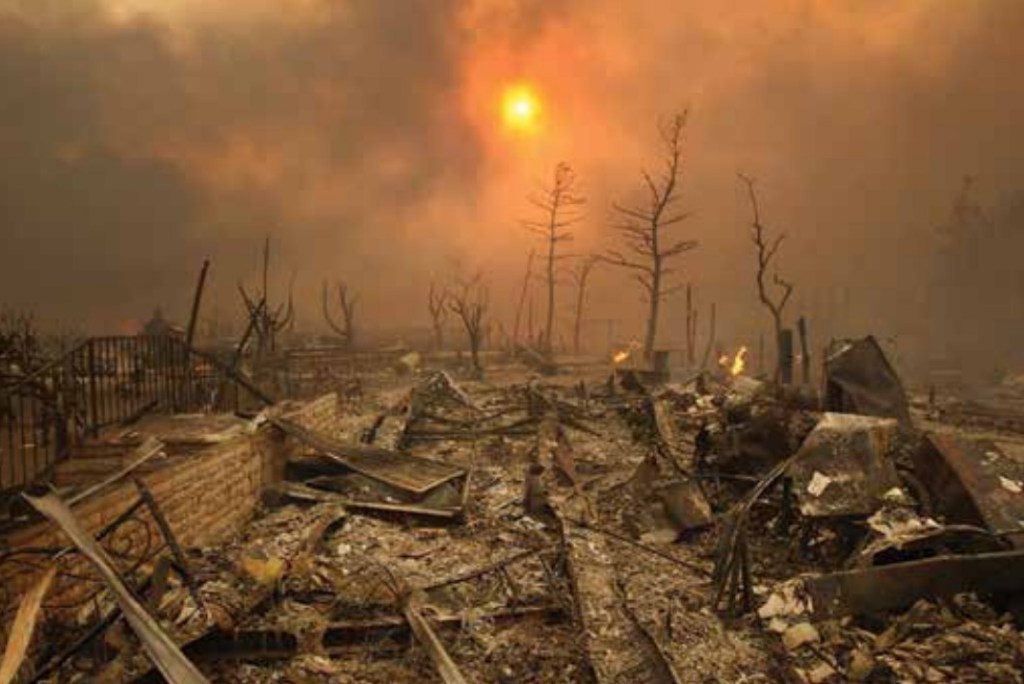
Another California subdivision destroyed by wildfire
As a California resident, I experienced firsthand its plummeting quality of life. But I was also an environmental professional who conducted many assessments under the California Environmental Quality Act that is now under attack by Governor Newsom, developers and YIMBY zealots. And I was an activist in the failed effort to force the Sierra Club — indigenous to California — and the larger environmental community to honestly acknowledge the environmental costs of mass immigration.
In the spring of 2026, NumbersUSA will release a new study on California that expands upon our pioneering 2000 study on population growth-driven sprawl. Its theme will be the lost middle-class paradise that was once California, undone by unremitting immigration-driven population growth.
We will examine not only sprawl’s profound transformation of the California landscape, but the environmental and quality-of-life malaise more broadly. That includes biodiversity loss, water scarcity, air quality, traffic congestion and the worsening threat of catastrophic megafires. Immigration-driven population growth has exacerbated all of these problems.
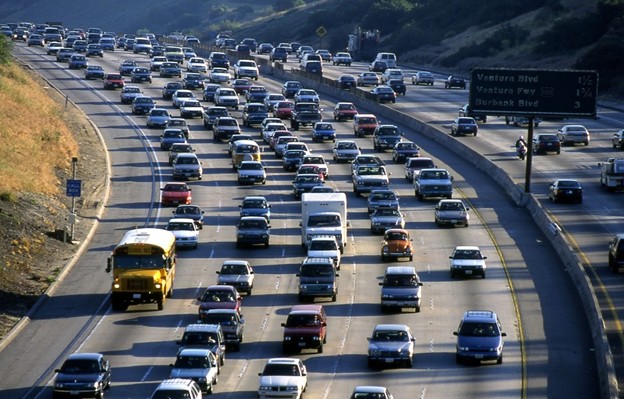
Worsening traffic congestion is a major quality of life concern for Californians
Our study will address other timely issues related to population growth, such as housing affordability, homelessness, and the shift from egalitarian opportunity to one of the most economically unequal states in the nation.
Finally, we will discuss how California is exporting its dire problems not just to other states in the West, but to much of the rest of the country. In a real sense, Californians are “sprawling” out into other states, “in search of what they once could find at home, and bringing sprawl and higher housing prices to the rest of the West,” in the cogent words of my co-investigator Phil Cafaro.
It is a cliché to proclaim that California is at a crossroads. In fact, the state’s leaders took the wrong path at that crossroads at least 30 years ago. But it is still possible to make better choices, salvage some of what was lost, and reclaim a more livable, sustainable future.
Massive population growth has damaged California and devastated its quality of life. Looking ahead, Californians have two possible paths. 1) They can encourage still more population growth, acquiesce to densification and roll back environmental protections, local zoning control and people’s quality of life. Or 2) they can embrace an end to population growth, preserve those open spaces and wildlands that still remain, and work to create a genuine rather than a faux sustainable society, as well as improve ordinary people’s quality of life.
I am certain that given a choice, most Californians would choose the latter path.
Related Resources


 Facebook
 LinkedIn
 Tweet
Tweet
 Email
Email
 Print
Print
 Videos

 Factsheets
 Articles