These amnesties granted permanent work permits and a path to U.S. citizenship.
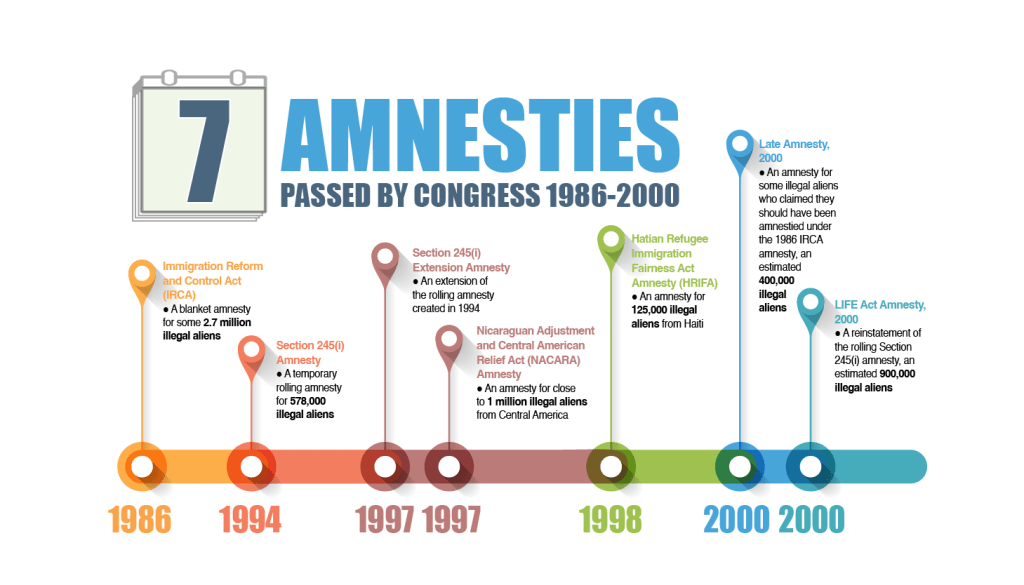
As if to say “we’ll mean it tomorrow, we don’t mean it now,” each of these were sold as a way to “wipe the slate clean,” only to yield bigger problems. The more often the government rewards law-breaking, the less credible the law. The world notices.
A. EXIT AMNESTY: The lawbreaker is forgiven the crime and not assessed the penalty. The Exit Amnesty waives one or more of the penalties the law currently assesses for illegal immigration, including civil and criminal penalties and bars on legal re-entry. An Exit Amnesty would, however, require illegal aliens to leave the United States.
B. REWARD AMNESTY: The lawbreaker is actually rewarded for lawbreaking by being given the very thing he/she attempted to steal in the first place. In the case of illegal aliens, most are seeking a job in the United States. A Reward Amnesty would give illegal aliens the legal right to work, either temporarily or permanently.
C. INSTANT JACKPOT AMNESTY: The lawbreaker wins the jackpot – he/she is instantly rewarded for breaking our immigration laws by being given lawful permanent resident status and put on the path to U.S. citizenship. Instant Jackpot Amnesties generally are limited to illegal aliens of a certain national origin (e.g., the Nicaraguan Adjustment and Central American Relief Act) or who are working in a particular occupation in the United States (e.g., the Special Agricultural Worker amnesty included in the Immigration Reform and Control Act).
D. MULTI-STEP JACKPOT AMNESTY: The lawbreaker is first given a Reward Amnesty (usually through a legal work permit and temporary resident status or “cancellation of removal”). After a period of time and usually after other criteria (e.g., holding a job; paying taxes; working in a particular industry), the formerly illegal alien is given lawful permanent resident status and put on the path to U.S. citizenship.
E. BLANKET AMNESTY: This is basically the Instant Jackpot Amnesty but for the entire population of illegal aliens (minus a few exceptions, such as certain criminals), although it may be limited to illegal aliens who have lived in the United States for a certain period. The “general amnesty” included in the 1986 Immigration Reform and Control Act, for example, was a Blanket Amnesty for all illegal aliens who had lived in the United States since January 1, 1982.
F. DE FACTO AMNESTY: This does not immediately reward illegal aliens with legal status but holds out the promise that if they avoid arrest long enough they will be exempted from the penalties for illegal immigration and granted legal status. The now expired Section 245(i) of the Immigration and Nationality Act is a De-Facto Amnesty because it says that all illegal aliens in the country who have the right through jobs or relatives to apply for lawful permanent resident status may do so from within this country with the tacit assurance that they may remain in this country illegally until their name comes up to the top of the list for a green card sometime in the future.
There are other rewards for illegal immigration beside amnesty, benefits to illegal immigration that serve as important pull factors, including healthcare, education, driver’s licenses, in-state tuition, and other public benefits.
One of the truly universally-accepted realities of migration is that the lure of jobs is the principle pull factor that leads to illegal immigration.
Every recent congress and administration has passively granted the jobs benefit by not requiring employers to use E-Verify, thus rewarding both the illegal worker and illegal employer by turning a blind eye to their bad behavior.
Sometimes the government doesn’t just turn a blind eye to illegal employment; it issues work permits to inadmissible aliens, and releases them into the interior with a request to come back years later for their day in court. This form of parole abuse and “catch-and-release” has become so prevalent that most people entering the country illegally turn themselves into border agents with the expectation of working (legally or illegally) inside the country within a few days.
Related Resources
 Factsheets
 November 4, 2023


 Facebook
 LinkedIn
 Tweet
Tweet
 Email
Email
 Print
Print
 Videos
 Articles