Tragically, she died just before Congress voted on the immigration recommendations she and her commission developed over the last years of her life.
To understand the rare and critical opportunity Congress has today to pass lasting immigration legislation, you must know about Barbara Jordan – and the final act of her remarkable public life.
Jordan was born in 1936, twelve years after the Immigration Act of 1924 ended The Great Wave of European migration.
As immigration from Europe slowed, Northern industrialists did the previously unthinkable: they sent recruiters to the far corners of the deep South to recruit workers they had long excluded – including descendants of slaves and American Freedmen. The new pipelines of opportunity fueled the Great Migration of Black Americans into the North and West.
Over the mid-20th century, real incomes rose dramatically:
These historic gains coincided with decades of immigration restraint, tight labor markets, and rising economic opportunity for America’s most vulnerable workers.
W.E.B. DuBois called the immigration slowdown “the economic salvation of American black labor.”
This was the backdrop of Jordan’s formative years.
She grew up during segregation and Jim Crow – but also witnessed the Great Leveling and the rise of the Black middle class. Along with economic gains, Black Americans gained new political power. In the year before Jordan was elected to the Texas State Senate, Congress passed the Civil Rights Act of 1965.
Four decades of economic empowerment had finally led to the dismantling of institutional barriers to social equality.
Within months of passing landmark civil rights legislation, however, Congress erected new barriers to economic opportunity by passing the misunderstood Immigration and Nationality Act of 1965.
Lawmakers believed they were eliminating discriminatory national origin quotas while preserving the stable immigration levels of the previous decades. Instead, they inadvertently launched a new era of mass immigration.
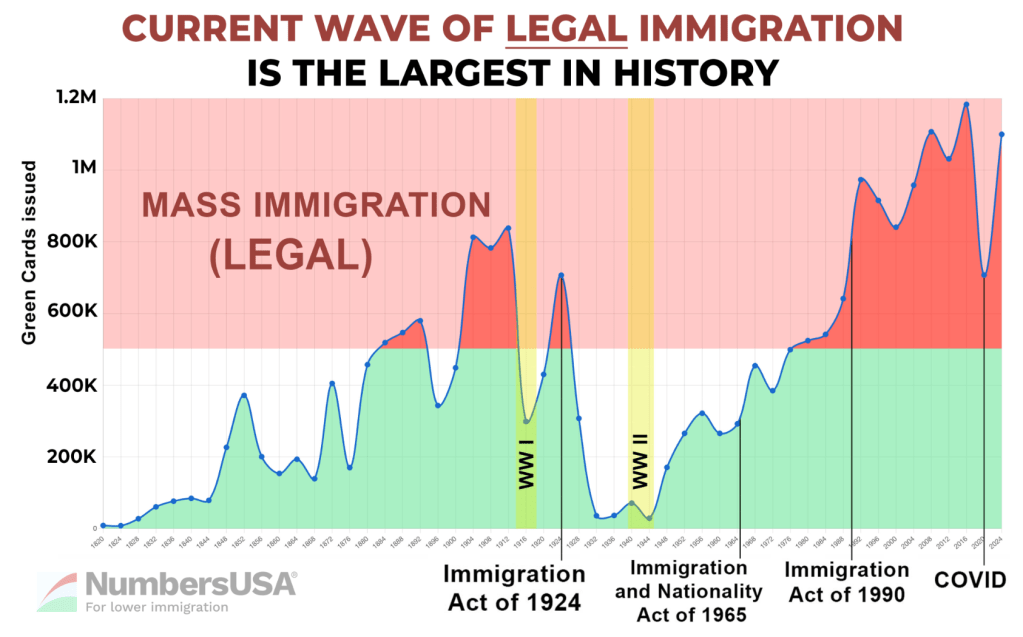
Immigration numbers almost immediately doubled. Decades of the declining inequality, expanding middle class, and shrinking racial wealth gaps that Jordan’s generation had known their whole lives were halted and reversed.
Barbara Jordan was just beginning her political career.
Few could have imagined that the broken promise of 1965 would remain unmended 30 years later when Jordan came out of political retirement to lead a commission of Democrats and Republicans to study mass immigration policies and issue recommendations to Congress.
Jordan was a brilliant choice. Congress had failed to deliver the promised workplace enforcement after granting amnesty to millions engaged in illegal hiring and work, and public faith in the immigration system was eroding.
America needed someone all sides respected to lead the commission, and Jordan had earned the nation’s respect.
Already regarded as one of the nation’s great orators, her career was marked by historic firsts, including becoming the first Southern Black woman elected to the U.S. House and the first woman to deliver a keynote address at a Democratic National Convention.
“If you want to know heat in its actuality,” Jordan – a proud Texan – remarked, “chair the bipartisan commission on immigration reform.”
She could stand the heat.
Jordan’s approach was effectively to take the best parts of the two immigration eras of her lifetime and bind them together.
The current system did away with national-origin quotas, but was/is fatally flawed with unsustainably high numbers that have made housing more expensive, our communities less stable, and good jobs less obtainable.
Jordan and her commission recommended a system that prioritized spouses, children, skills, and needs — America’s needs, specifically. Her system would give anyone in the world a chance, regardless of race, color, or creed – but it would be limited in the national interest.

Jordan believed in welcoming immigrants into the American community. A civil-rights icon herself, Jordan rejected discrimination and bigotry outright.
But she was adamant that immigration policy must serve the national community – especially its most vulnerable members.
She made no apology for setting limits, and she advocated for enforcement that would give those limits credibility.
Barbara Jordan’s unimpeachable voice was silenced 30 years ago on January 17 when she succumbed to complications from pneumonia after a long battle with multiple sclerosis. In her final months, she continued advancing her vision from a wheelchair.
Congress voted on her recommendations just months later–without her.
We can never know for sure, but Congress likely would have passed her vision had Jordan lived. Her absence from the stage was as powerful as her presence, and the leadership vacuum left in the wake of her death was quickly filled with lobbies from the left and the right that had special interests in maintaining mass immigration.
In the end, Jordan’s recommendations were either watered down in the final bill or removed entirely.
For thirty more years, Congress has allowed immigration at roughly twice the level Jordan advised.
NumbersUSA was founded the year Barbara Jordan died. From day one, we have advocated for her commission’s recommendations. Her work in the last years of her life — in the last act of public service to her country — is at the core of our work.
Jordan’s justifications for curbing mass immigration remain accurate:
And while the border is quieter today, Congress has not locked in those gains.
This Congress presents the best opportunity to stabilize immigration at sustainable levels since Jordan led the effort.
We cannot wait for another Barbara Jordan.
Jordan believed in the national community. She believed in democracy. When we act together, using the tools of democracy, we provide yet one more piece of evidence that – as she herself once said – “the American dream need not forever be deferred.”
Related Resources
 Articles
 November 20, 2009


 Facebook
 LinkedIn
 Tweet
Tweet
 Email
Email
 Print
Print
 Videos
 Factsheets